Lighting plays a decisive role in how workplaces function. It influences focus, energy, comfort, and how a space is experienced throughout the day. As offices continue to function fluidly as multi-use environments, lighting should offer flexibility of design, without compromising visual quality or performance.
Track lighting systems meet that brief, but what are key design principles to remember?
DESIGNING FOR TODAY AND TOMORROW
Fixed lighting layouts can quickly become a limitation in these conditions, often requiring costly alterations long before luminaires reach the end of their working life.
Track lighting offers a different approach. Luminaires can be repositioned, added, or re-aimed as layouts change, allowing lighting to adapt alongside the space rather than restrict it. This makes track systems particularly suited to offices designed for long-term use in CAT A schemes, as lighting elements are modular and can be easily reconfigured to suit future tenants.
CAT B fit-outs highlight a recurring issue within the industry: large volumes of perfectly serviceable luminaires are routinely removed and discarded as layouts change. This cycle of premature replacement contributes to avoidable material waste and embodied carbon, often long before products reach the end of their technical life. Designing for adaptability from the outset helps break this pattern, extending product lifespans and reducing unnecessary environmental impact.
ARCHITECTURAL PRECISION
Workplace lighting must balance technical performance with architectural intent.
Track systems allow light to be placed precisely where it is needed, while keeping ceiling layouts clean and legible.
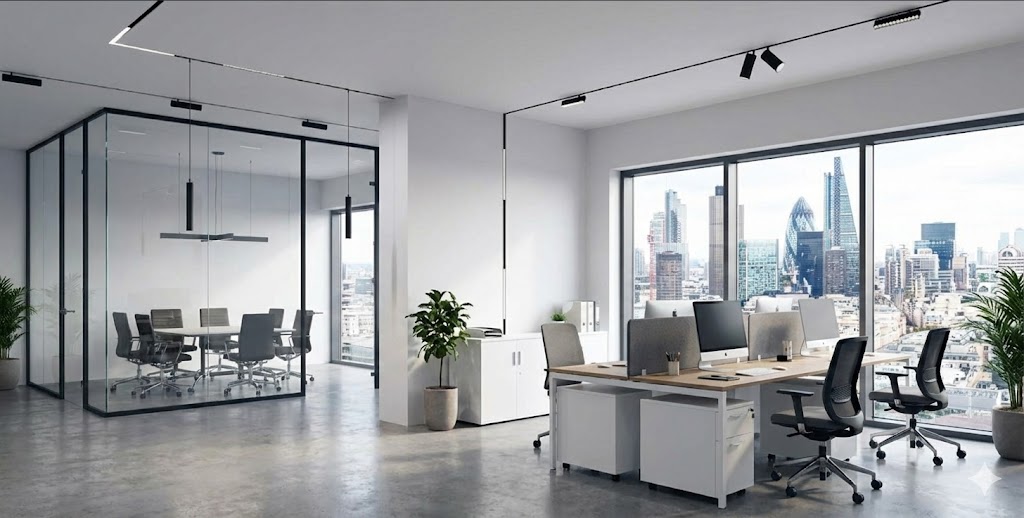
Track systems can be recessed into your ceiling for a discreet finish, or suspended to subtly define zones within open-plan spaces. This versatility allows track lighting to integrate comfortably into a wide range of interior styles, from minimalist to biophilic to industrial.
TRACK LIGHTING ACROSS WORKPLACE ZONES
Track lighting systems perform well across varied office settings due to their adaptability.
In open-plan offices, adjustable luminaires help create balanced illumination across workstations and circulation areas, reducing glare and supporting visual comfort. As desk layouts change, lighting can be repositioned without redesigning the entire scheme.
In meeting rooms, lighting requirements vary depending on use. Presentations, video conferencing, and collaborative sessions all place different demands on light quality. Track lighting allows these spaces to be easily adjusted to suit different activities by the press of a scene-control button.
In collaboration and breakout areas, lighting needs to feel both functional and welcoming. Track systems support this by combining focused lighting with softer ambient layers, helping spaces feel comfortable while remaining practical.

INTEGRATING LIGHTING CONTROL SYSTEMS
Environmental impact is obviously a core consideration in workplace lighting design, and this needs to be considered not only from a materials used perspective, but the day-to-day performance. Track lighting systems offer an infrastructure to integrate controls & other electrical services easily, using it’s power and data lines in-built.
When deployed, lighting control systems respond to occupancy, daylight, scheduling and user interaction. This helps reduce energy demand, preserve component lifespans, improve user comfort, and provide maintenance testing & reporting.
EASE OF MAINTENANCE
Consider the lifetime of your design, specifying reliable industry track systems, where compatibility of luminaires is easy across manufacturers, handled by your maintenance provider.
Avoid ‘proprietary’ control systems & track systems unless absolutely necessary, as this reduces your risk of being held at the mercy of the sole supplier for warranty support, replacements and future adaptation.
Reducing SKU’s is helpful from a design, maintenance & manufacturing perspective, so grouping similar products together allows re-purposing to suit alterations, as well as integrating greater functionality into products for future use, such as dynamic tuneable white, which can also be used for static fixed colour in commissioning.